

 +86 25 6959 8899
 sales@chamlion.com
2020 官网升级中!现在您访问官网的浏览器设备分辨率宽度低于1280px请使用高分辨率宽度访问。


When discussing metal 3D printing for removable partial denture (RPD) frameworks, attention is often focused on printer specifications, materials, and scanning accuracy. However, another critical factor can significantly influence print quality, dimensional stability, and production efficiency: build orientation.
Different framework designs require different nesting strategies. There is no single orientation that works for every case. Experienced production teams select the most appropriate build angle based on framework geometry, deformation risk, surface quality requirements, and delivery timelines.
This article introduces three commonly used nesting strategies for metal 3D printed RPD frameworks and explains their advantages, limitations, and ideal applications.
1. Flat Orientation
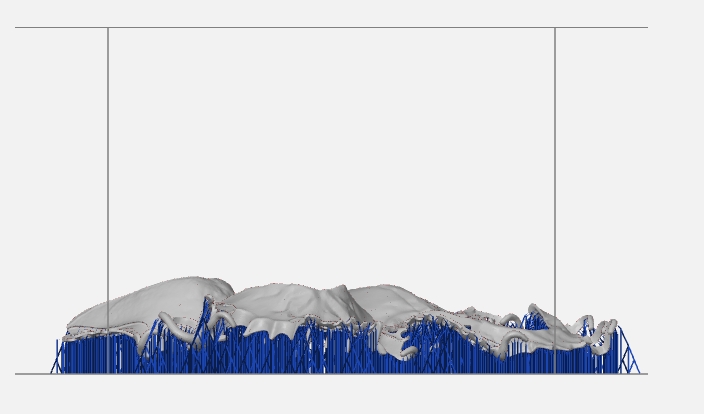
Characteristics
Flat orientation is typically used for frameworks with large plate-like structures, such as palatal plates, lingual plates, and lingual bars. The framework is positioned at a relatively low angle, usually between 0° and 20° relative to the build platform.
Advantages
A larger contact area with the build platform improves thermal stability during printing.
More uniform heat distribution helps reduce shrinkage stress and minimizes deformation risk in thin structures.
High-quality fitting surfaces can be achieved, making this method suitable for frameworks where adaptation accuracy is critical.
Requires fewer manually added supports compared with steeper orientations.
Limitations
Lower packing density results in fewer frameworks per build.
Larger support-contact areas increase post-processing and polishing time.
Higher production cost per framework due to lower platform utilization.
Typical Applications
Flat orientation is commonly selected for:
Palatal plate frameworks
Lingual plates
Lingual bars
Cases with strict fit requirements
Frameworks that are particularly prone to deformation
2. Angled Orientation
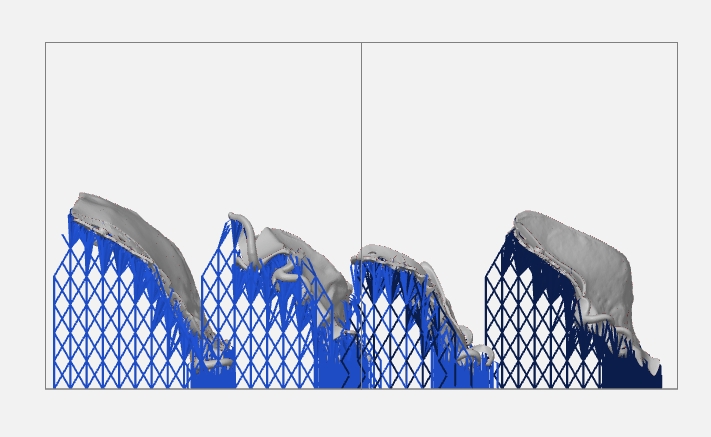
Characteristics
Angled orientation is the most widely used nesting strategy in dental metal additive manufacturing. Frameworks are positioned between 20° and 80°, with the exact angle determined by framework type and customer requirements regarding surface quality, fit, and turnaround time.
In practice, angled orientation can be divided into three categories:
Low Angle (20°–40°)
Suitable for high-precision cases, deformation-sensitive frameworks, and customers with strict quality requirements.
Medium Angle (40°–60°)
The most common configuration, providing a balance between printing quality and production efficiency.
High Angle (60°–80°)
Often used when preserving surface texture is a priority and minor dimensional deviations are acceptable.
Advantages
Good balance between quality and productivity.
Higher platform utilization compared with flat orientation.
Better preservation of surface details and framework textures.
Moderate post-processing workload.
Limitations
Additional supports may be required for deformation-prone areas.
Careful support placement is necessary to maintain fitting accuracy in critical regions.
Typical Applications
Angled orientation is suitable for most conventional RPD frameworks and is often considered the standard choice for daily production.
3. Near-Vertical Orientation
Characteristics
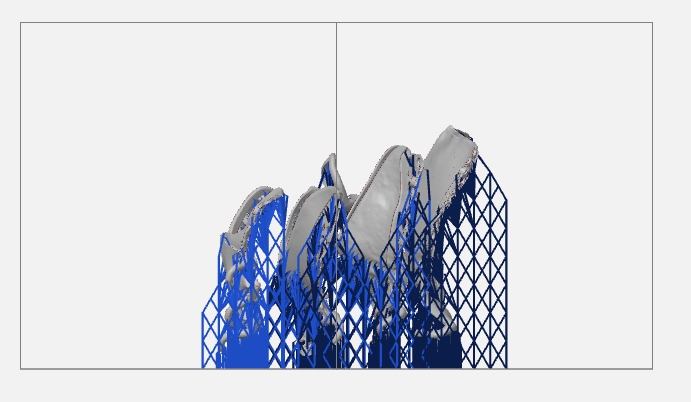
In near-vertical orientation, maxillary and mandibular frameworks are positioned with the opening facing downward at approximately 80°–90° relative to the build platform.
This approach prioritizes platform utilization and production capacity.
Advantages
Maximizes build volume and platform efficiency.
Significantly increases the number of frameworks that can be printed in a single build.
Reduces support contact on critical fitting surfaces.
Well suited for high-volume production and fast delivery requirements.
Limitations
Longer build times due to increased height.
Support marks may remain in localized areas, such as clasp interiors, proximal plates, and mandibular opening regions.
Requires robust support design and careful process control.
Insufficient support placement can increase the risk of local defects or even build failure.
Typical Applications
Near-vertical orientation is commonly used for:
Lingual plate frameworks
High-volume production environments
Cases where minor support marks are acceptable
Customers prioritizing throughput and turnaround time
Finding the Right Balance
Selecting the optimal build orientation is not simply a matter of fitting more frameworks onto the platform.
Each nesting strategy involves trade-offs between:
Dimensional accuracy
Framework fit
Surface quality
Support removal effort
Production efficiency
Manufacturing cost
For this reason, experienced production teams evaluate each case individually rather than applying a single orientation to every framework.
As metal dental 3D printing continues to evolve, build orientation remains one of the most important factors influencing the consistency and quality of printed RPD frameworks. Understanding these different nesting strategies helps dental laboratories make better decisions when balancing quality requirements, delivery timelines, and production efficiency.
 language